The Anatomy of a Reader: This Simple Graphic Will Change How You See Literacy
Learning to read isn’t a single skill. And it definitely isn’t something kids “just pick up” on their own. It’s a full-body experience.
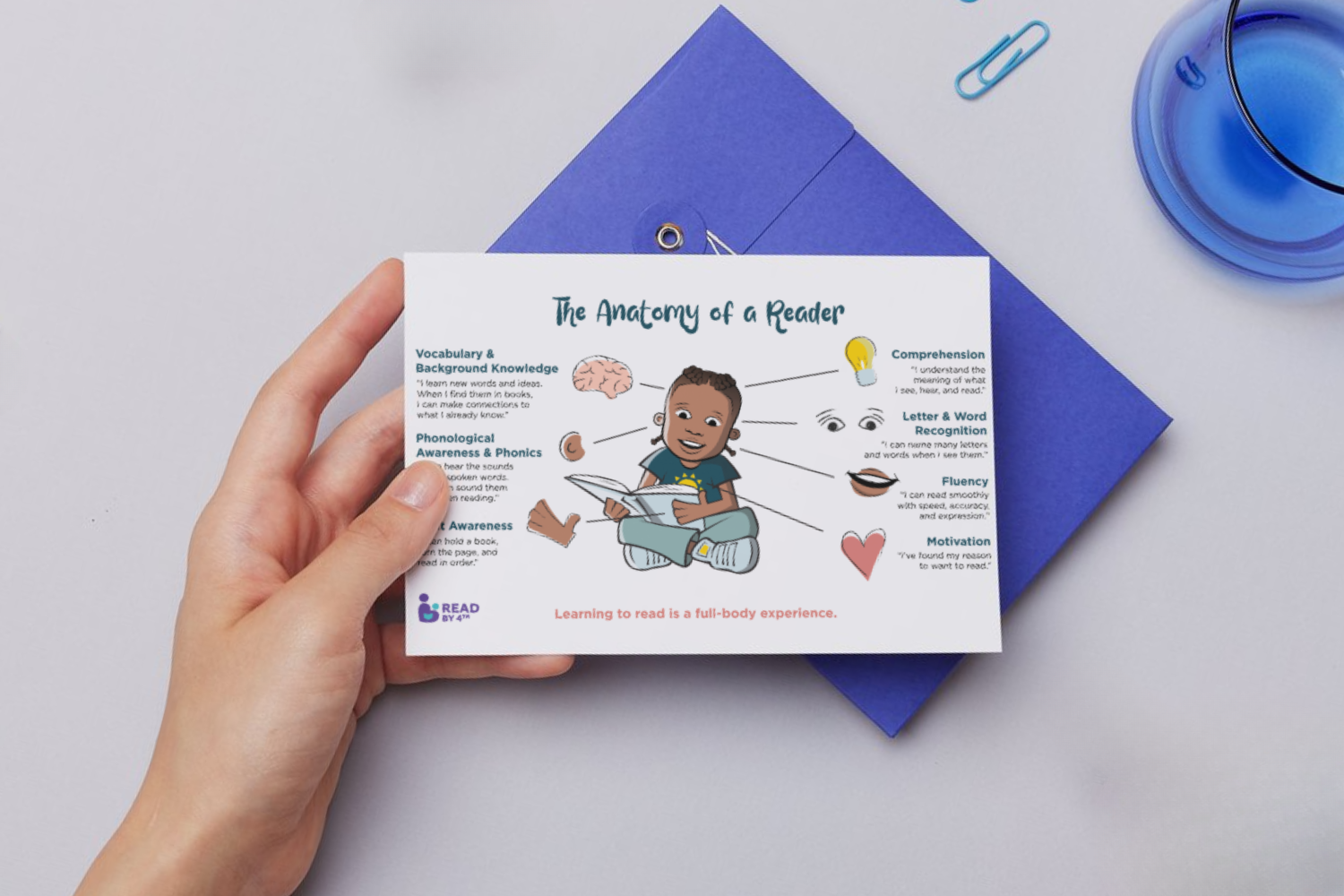
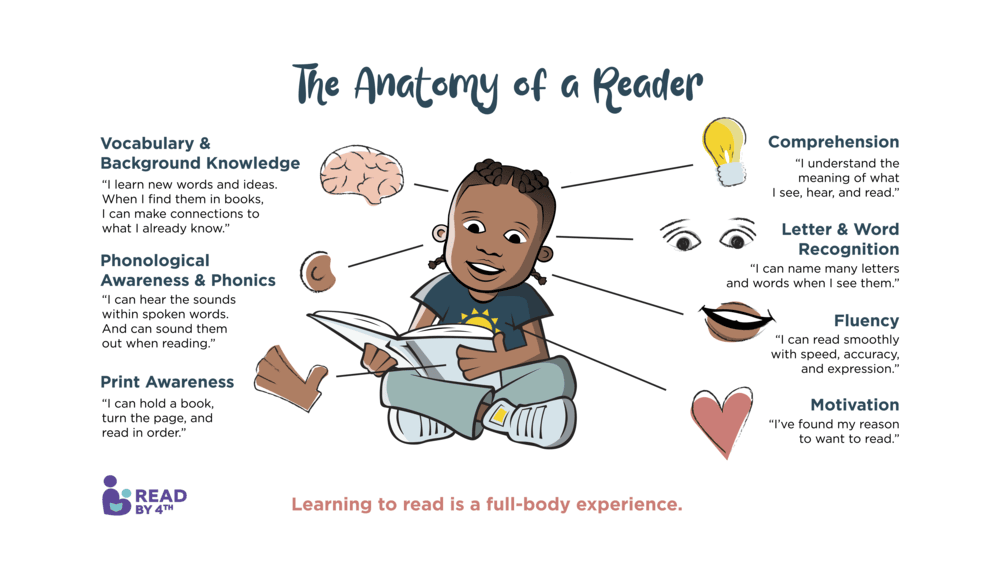
That’s the idea behind Read by 4th’s Anatomy of a Reader, a simple, visual tool that shows families, community members, and partners what actually goes into learning to read, and why every piece matters.
Why We Made It
When we talk about the Science of Reading, some people tune out.
The research is clear, but the language? Technical, academic, and intimidating. For some parents and caregivers, that gap between wanting to help and knowing how can feel huge.
At the same time, teachers are talking about phonemic awareness. Schools are sending home progress reports filled with acronyms. And families are left wondering: Am I doing this right? Is my kid okay? What am I missing?
So we asked ourselves a few questions:
How might shared language support solving the early literacy crisis?
How might we make how kids learn to read and the Science of Reading visible, not abstract?
How can we show that reading is something kids build with support, not something they’re born good or bad at?
The Anatomy of a Reader is our answer.
Making Literacy Human
Metaphors help people understand complex ideas fast.
Instead of centering scientific jargon or the brain alone, The Anatomy of a Reader graphic centers what matters most: the reader. It’s explained in plain language, through a child’s voice.
We map the key parts of reading onto the body; feeling a book in your hands, hearing words with your ears, reading smoothly with your mouth. By grounding reading skills in familiar physical sensations, abstract literacy terms become concrete, relatable, and easier to understand.
Here’s what this graphic makes easier to talk about:
Reading is a complex system, not a single skill. Most adults already know a healthy body needs many parts to work; heart, lungs, brain, muscles. You can’t skip one and expect the system to thrive. Reading works the same way. It’s a network of skills that interact and develop together. This graphic shows just how many pieces come together to support learning to read.
Kids don’t learn to read alone, they must be taught. Just like growing a healthy body, learning to read requires support. Children need caring adults at home, in classrooms, and across their community. Reading doesn’t come automatically; it requires evidence-based instruction. It also depends on well-funded schools, smart education policies, and a whole lot of love.
Every reader is unique, and that’s completely normal. Some kids have huge vocabulary but struggle with fluency. Others can sound out words perfectly but don’t fully understand what they read. Literacy skills develop in overlapping, messy ways. This graphic helps us see and normalize those differences. Every reader is built differently and that’s okay.
The Shift We're After
Using the body shifts the focus from labels and age-based benchmarks to skills.
Instead of only asking, “Is this child on grade level?” we can go deeper:
"Which skills are strong?"
"Which need more support right now?"
"What can we celebrate? What needs practice?"
That shift matters.
It opens up conversations without the shame or stigma of being behind. Whether it's a kindergartener just starting out or an adult learning to read. The needs might look different, but the foundational skills are the same.
Why We Think This Works
This graphic is rooted in a few simple behavioral science principles:
Make it visual: Most people process images faster than text.
Reduce cognitive load: Plain language lowers the barrier to entry.
Use familiar frames: A body is intuitive. No explanation required.
Build confidence: When adults understand how reading develops, they feel more capable of supporting kids.
When families and schools speak the same language, everyone gets stronger.
How to Use It
You don’t need to be a reading expert, The Anatomy of a Reader is for everyone!
For families and community members:
Print it. Stick it on your fridge.
Bring it to parent-teacher conferences and ask better questions.
Share it with grandparents, babysitters, tutors, or anyone who spends time with your reader.
Let it be a reminder: every reader is built differently, and that’s ok.
For educators and Read by 4th partners:
Use it in family workshops and literacy nights.
Include it in back-to-school packets or welcome folders.
Bring it to staff trainings or advocacy meetings.
Print it big for your classroom or library wall.
The Anatomy of a Reader is a conversation starter. A tool that helps everyone get on the same page.
Download the Anatomy of a Reader for free today. And let us know how you are using it in your community.