Tutoring is now understood to be one of the most effective strategies for helping children learn. Every year, programs and schools across Philadelphia mobilize to provide reading tutoring to as many students as they can. How does what’s happening in Philadelphia hold up to the latest research on reading tutoring?
The research on tutoring offers important guidance about what makes programs effective. But translating research into practice is not always straightforward. Across Philadelphia, literacy organizations and schools work every day to balance evidence-based practices with the logistical and financial realities of serving students at scale.
This blog post is grounded in an in-depth evaluation of four Philadelphia-based literacy programs from 2022-25 conducted by Research for Action, and a high-level scan of the research and other programs conducted by Read by 4th.
Start tutoring young
What the Research Says
A large meta-analysis of nearly 100 experimental tutoring studies found that tutoring effects were strongest in the earliest grades, particularly in reading.
What We Observed in Philadelphia
Philadelphia’s tutoring landscape largely reflects this research. Most literacy programs in the evaluation focused primarily on elementary-aged students, particularly in grades K–5.
This alignment also reflects a practical reality: schools and programs increasingly recognize that waiting until students are much older can make intervention more difficult and resource-intensive. Many organizations prioritized early literacy support in hopes of helping students build strong reading foundations before gaps widen.
Aim for “high dosage” tutoring
What the Research Says
“High-dosage” tutoring is defined as at least three 30-minutes sessions per week. This dosage of tutoring is associated with the strongest academic gains in the research.
What We Observed in Philadelphia
Delivering high-dosage tutoring consistently is difficult in practice.
Programs had to navigate school schedules, transportation challenges, student absences, staffing limitations, and competing demands on instructional time. Some programs met the high-dosage threshold consistently, while others struggled to do so. At the same time, lower-dosage programs still often produced positive outcomes for students.
The evaluation also highlighted an important nuance in interpreting results. Counterintuitively, students with the most tutoring hours within a program may sometimes show smaller gains on paper than their peers with fewer tutoring hours. Students receiving the most tutoring are often the students with the greatest academic needs and they require the most intensive support to catch up.
Hire highly qualified, experienced tutors
What the Research Says
Research finds that more experienced instructors, such as certified teachers, deliver the strongest academic gains for students.
What We Observed in Philadelphia
Many tutoring programs relied on paraprofessionals, including community members, AmeriCorps members, and college students, rather than certified teachers or reading specialists. Despite varying levels of prior experience, we still observed high-quality instruction across programs.
One reason appeared especially important: coaching. Inexperienced tutors consistently pointed to strong training and ongoing coaching support as the primary reason they felt successful in the role. Programs that invested heavily in observation, feedback, and instructional modeling were often able to close experience gaps quickly.
This finding reinforces an important point for the field: effective tutoring depends not only on who tutors are, but also on how they are trained and supported.
Use assessments to plan instruction and measure growth
What the Research Says
Frequent progress monitoring helps instructors tailor instruction and respond to student needs.
What We Observed in Philadelphia
Programs relied heavily on assessment data to guide instruction, but in many cases this contributed to potential over-assessment.
Some students participated in assessments through their school, their school-day tutoring program, and their afterschool program simultaneously. Programs often had to balance the value of data collection against the reality that every assessment consumed time that could otherwise be spent reading with students. This tension raises important questions for the field about how to gather meaningful instructional data without overwhelming students or reducing instructional time.
Relationships matter
What the Research Says
Strong tutor-student relationships improve engagement and persistence.
What We Observed in Philadelphia
This finding was consistently reflected across programs.
Programs frequently described relationship-building as central to their success, especially for students who had already experienced academic frustration. Tutors encouraged students, celebrated progress, and helped create emotionally safe learning environments.
One area that deserves greater emphasis in future research and program design is behavior management training. Programs consistently noted that tutors needed support not only in literacy instruction, but also in helping students regulate emotions, stay engaged, and rebuild confidence as readers.
Philadelphia’s literacy programs demonstrate that tutoring is not a single, rigid model. Effective programs share common foundations, including targeting the right students, maximizing instructional time, ongoing training for tutors, data-informed instruction, and relationship-building with students. Programs also need to be responsive to the realities of schools and communities, including staffing limitations, scheduling constraints, and long-term financial sustainability.
As Philadelphia continues expanding literacy support for students, the conversation should not simply focus on whether programs perfectly replicate research conditions. It should also focus on how communities can build sustainable, flexible tutoring models that remain grounded in evidence while responding to real-world needs.
A recent landscape scan conducted by Read by 4th revealed that the need for tutoring remains enormous. Expanding access will require continued investment, stronger coordination across programs, and support for the organizations already doing this work every day.
How Supporters Can Help
Support local literacy and tutoring organizations
Volunteer as a reading tutor
Advocate for sustained literacy funding
Encourage schools and community organizations to collaborate around tutoring access and data sharing
Tutoring programs can change reading trajectories for children. Philadelphia already has strong programs in place; the challenge now is scaling and strengthening that work.
Sources and Further Reading
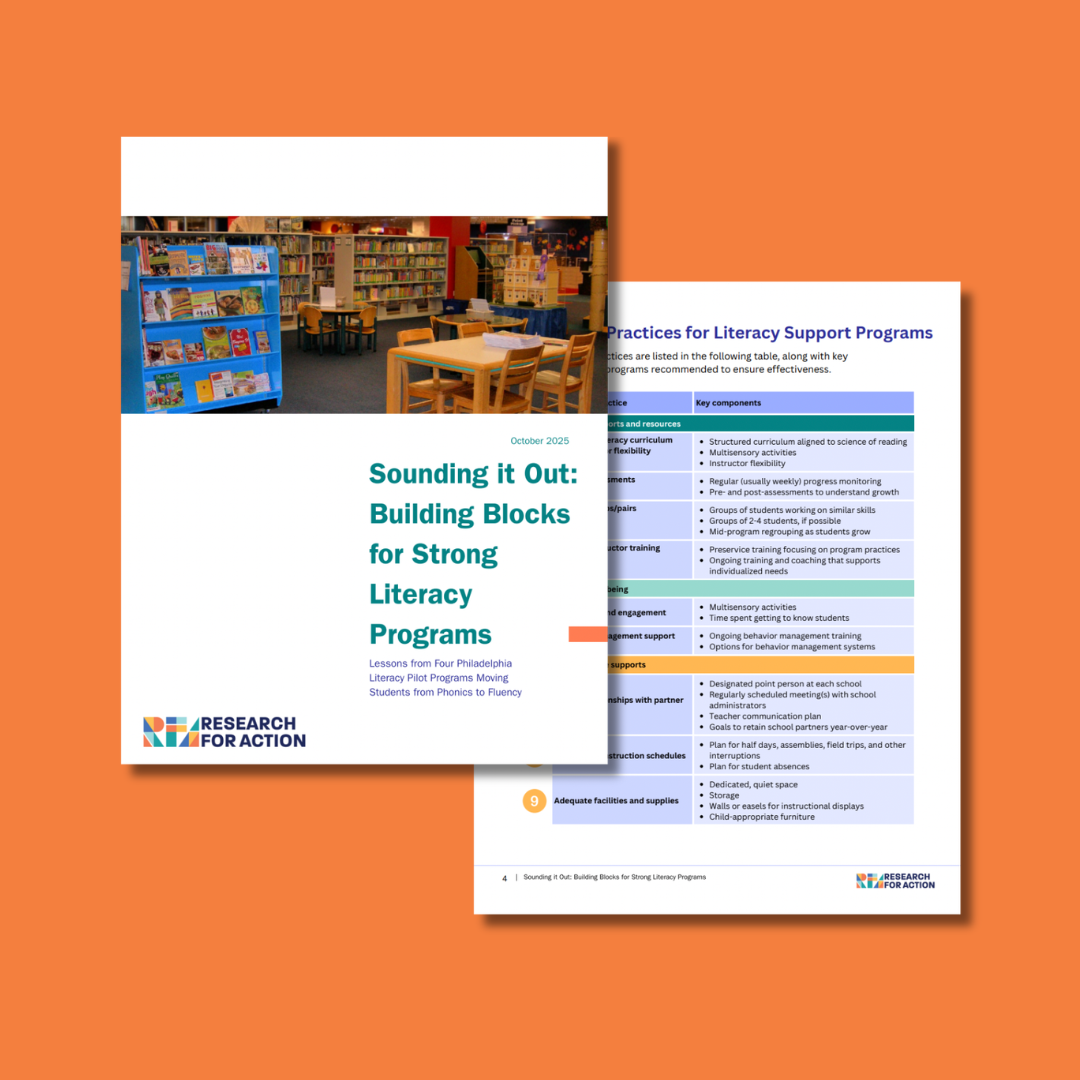
Research for Action’s Literacy Program Practice GuidesThree reports produced in the course of a three-year evaluation of four literacy programs in Philadelphia conducted by Research for Action with the support of the William Penn Foundation.
Sounding it Out: Building Blocks for Strong Literacy Programs highlights concrete, evidence-aligned “promising practices” that programs can use to boost student engagement and skill-building.
Assessments for Literacy Programs practice guide offers a practical guide to selecting and using early-literacy measures (e.g., what each tool captures) to support day-to-day decision-making and longer-term evaluation.
Instructor Training for Literacy Programs outlines scalable approaches to building tutor/teacher capacity so programs can deliver consistent, high-quality instruction.
The Impressive Effects of Tutoring on PreK–12 Learning (NBER) A large meta-analysis of nearly 100 experimental tutoring studies examining which tutoring models are most effective across grade levels and subjects.
Academic Interventions for Students with Low Socioeconomic Status A meta-analysis comparing the effectiveness of different educational interventions for students experiencing poverty, including tutoring programs.
A Systematic Review of Research on Tutoring Implementation (Annenberg Institute) A review focused on the practical realities of implementing tutoring programs at scale, including staffing, scheduling, and instructional quality.
ABOUT THE AUTHOR

Kendall LaParo, PhD is a quantitative researcher with more than fifteen years of experience across K–12 education, higher education, and nonprofit settings. Her work focuses on using data and research to advance more equitable outcomes for students and communities.
Throughout her career, Kendall has led research and evaluation efforts centered educational access and social inequality. She specializes in translating complex data into practical insights that help organizations strengthen programs, improve decision-making, and better serve students. Kendall is dedicated to using research to promote racial and socioeconomic justice.